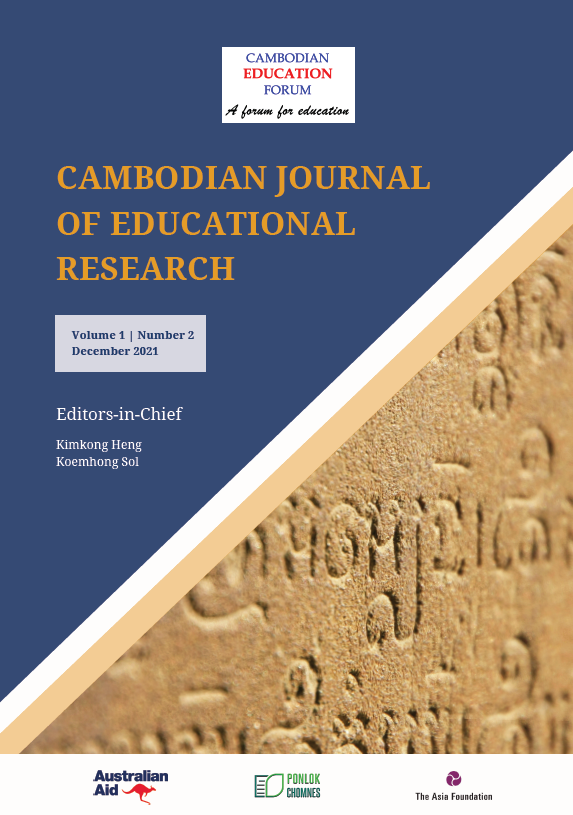
E-readiness of Cambodian undergraduate students in using Google Classroom
DOI:
https://doi.org/10.62037/cjer.2021.01.02.08Keywords:
E-readiness, Google Classroom, undergraduate students, CambodiaAbstract
This article reports key findings of a study that investigated Cambodian undergraduate students’ e-readiness in using Google Classroom. The study employed a closed-ended questionnaire as a data collection instrument to explore different dimensions of e-readiness. The results revealed that most of the Cambodian undergraduate students who participated in the survey (n = 110) were moderately ready for Google Classroom; however, some of them were concerned about whether their qualifications obtained from online learning via Google Classroom would be recognized. The study suggested that Cambodian undergraduate students need more exposure to Google Classroom to take advantage of its various features. Future studies should extend the scope of the current study and examine the technology acceptance of Cambodian students from different universities to understand how they navigate the challenges and opportunities of online learning.
Downloads
References
Almishiki, A. (2017). Using electronic classrooms in training: Experimenting with Google Classroom. https://www.mozn.ws/13950/
Alqahtani, A. (2019). Usability testing of Google cloud applications: Students' perspective. Journal of Technology and Science Education, 9(3), 326-339. http://dx.doi.org/10.3926/jotse.585
Bayarmaa, N., & Lee, K. (2018). A study on the application of Google Classroom for problem-based learning. Journal of the Korea Academia-Industrial Cooperation Society, 19(7), 81-87. https://doi.org/10.5762/KAIS.2018.19.7.81
Blau, I., Shamir-Inbal, T., & Avdiel, O. (2020). How does the pedagogical design of a technology-enhanced collaborative academic course promote digital literacies, self-regulation, and perceived learning of students?. The Internet and Higher Education, 45(100722), 1-11. https://doi.org/10.1016/j.iheduc.2019.100722
Brodahl, C., Hadjerrouit, S., & Hansen, N. K. (2011). Collaborative writing with Web 2.0 technologies: Education students' perceptions. Journal of Information Technology Education: Innovations in Practice, 10, 74-103. http://www.jite.org/documents/Vol10/JITEv10IIPp073-103Brodahl948.pdf
Chou, P. N., & Chen, H. H. (2008). Engagement in online collaborative learning: A case study using a web 2.0 tool. Journal of Online Learning and Teaching, 4(4), 574-582. https://jolt.merlot.org/vol4no4/chou_1208.pdf
Chung, E., Subramaniam, G., & Dass, L. C. (2020). Online learning readiness among university students in Malaysia amidst COVID-19. Asian Journal of University Education, 16(2), 46-58. http://files.eric.ed.gov/fulltext/EJ1267359.pdf
Etherington, D. (2017, April 28). Google Classroom now lets anyone school anyone else. TechCrunch. https://techcrunch.com/2017/04/27/google-classroom-now-lets-anyone-school-anyone-else/?guccounter=1
Fang, X., & Holsapple, C. W. (2007). An empirical study of web site navigation structures' impacts on website usability. Decision Support Systems, 43(2), 476-491. https://doi.org/10.1016/j.dss.2006.11.004
Kahn, J. (2014, August 12). Google Classroom now available to all apps for education users, adds collaboration features. 9TO5Google. https://9to5google.com/2014/08/12/google-classroom-now-available-to-all-apps-for-education-users-adds-collaboration-features/
Kassy, S. (2019). E-readiness in using Google Classroom among Cambodian undergraduate students [Unpublished Master’s Research Paper, University of Cambodia]. https://www.academia.edu/49184213/E_readiness_in_using_Google_Classroom_among_Cambodian_Undergraduate_Students
Madhavi, B. K., Mohan, V., & Nalla, D. (2018). Improving attainment of graduate attributes using Google Classroom. Journal of Engineering Education Transformations, 31(3), 200-205. http://dx.doi.org/10.16920/jeet%2F2018%2Fv31i3%2F120792
Magid, L. (2014, May 6). Google Classroom offers assignment center for students and teachers. Forbes. https://www.forbes.com/sites/larrymagid/2014/05/06/google-classroom-offers-control-center-for-students-and-teachers/?sh=37774b0a4d66
Pardo-Bunte, M. (2021, July 21). Google Classroom review. BetterBuys. https://www.betterbuys.com/lms/reviews/google-classroom/
Power, M., & Vaughan, N. (2010). Redesigning online learning for graduate seminar delivery. International Journal of E-Learning & Distance Education, 24(2), 19-38. http://www.ijede.ca/index.php/jde/article/view/649
Raman, M., Ryan, T., & Olfman, L. (2005). Designing knowledge management systems for teaching and learning with Wiki technology. Journal of Information Systems Education, 16(3), 311. http://jise.org/volume16/n3/JISEv16n3p311.html
Ressler, G. (2017, March 15). Google Classroom: Now open to even more learners. The Keyword. https://blog.google/outreach-initiatives/education/google-classroom-now-open-even-more-learners/
Rick, J., & Guzdial, M. (2006). Situating CoWeb: A scholarship of application. International Journal of Computer-Supported Collaborative Learning, 1, 89-115. https://doi.org/10.1007/s11412-006-6842-6
Suwantarathip, O., & Wichadee, S. (2014). The effects of collaborative writing activity using Google Docs on students' writing abilities. Turkish Online Journal of Educational Technology-TOJET, 13(2), 148-156. http://files.eric.ed.gov/fulltext/EJ1022935.pdf
Zhang, M. (2016). Teaching with Google Classroom. Packt Publishing. https://www.packtpub.com/product/teaching-with-google-classroom/9781786466280
Zhou, W., Simpson, E., & Domizi, D. P. (2012). Google Docs in an out-of-class collaborative writing activity. International Journal of Teaching and Learning in Higher Education, 24(3), 359-375. https://files.eric.ed.gov/fulltext/EJ1000688.pdf
Downloads
Published
How to Cite
Issue
Section
License

This work is licensed under a Creative Commons Attribution-NonCommercial-ShareAlike 4.0 International License.
The articles published by this journal are licensed under a Creative Commons Attribution 4.0 International License, which permits use, sharing, adaptation, distribution and reproduction in any medium or format, as long as you give appropriate credit to the original author(s) and the source, provide a link to the Creative Commons licence, and indicate if changes were made.